Greenhouse Effect
Problem we now face is that human activities – particularly burning fossil fuels (coal, oil and natural gas), agriculture and land clearing – are increasing the concentrations of greenhouse gases. This is the enhanced greenhouse effect, which is contributing to warming of the Earth.
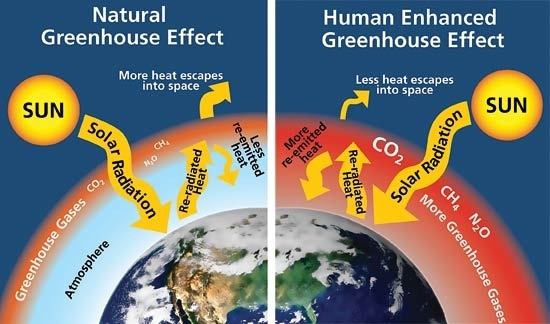
Life on Earth depends on energy coming from the sun. About half the light reaching Earth’s atmosphere passes through the air and clouds to the surface, where it is absorbed and then radiated upward in the form of infrared heat. About 90 percent of this heat is then absorbed by the greenhouse gases and radiated back toward the surface, which is warmed to a life-supporting average of 59 degrees Fahrenheit (15 degrees Celsius).
Causes of Greenhouse Effect
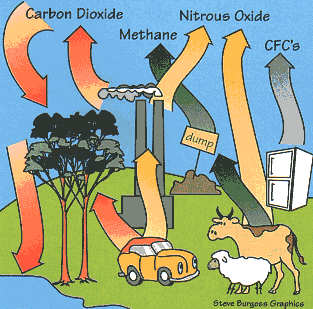
- Carbon dioxide from the burning of fossil fuels is the largest single source of greenhouse gas emissions from human activities. The supply and use of fossil fuels accounts for about three quarters of mankind’s carbon dioxide (CO2) emissions (equal to some 5.9 billion metric tonnes of carbon in 1992), one-fifth of the methane (CH4), and a significant quantity of nitrous oxide (N2O). It also produces nitrogen oxides (NOx), hydrocarbons (HCs), and carbon monoxide (CO), which, though not greenhouse gases themselves, influence chemical cycles in the atmosphere that create or destroy other greenhouse gases, such as tropospheric ozone. Meanwhile, fuel-related releases of sulphate aerosols are temporarily masking part of the warming effect of greenhouse gases.
- Most emissions associated with energy use result when fossil fuels are burned. Oil, natural gas, and coal (which emits the most carbon per unit of energy supplied) furnish most of the energy used to produce electricity, run automobiles, heat houses, and power factories. If fuel burned completely, the only by-product containing carbon would be carbon dioxide. But combustion is often incomplete, so carbon monoxide and other hydrocarbons are also produced. Nitrous oxide and other nitrogen oxides are produced because fuel combustion causes nitrogen in the fuel or air to combine with oxygen in the air. Sulphur oxides (SOx) result when sulphur (primarily from coal and heavy fuel oil) combines with oxygen; the resulting sulphate aerosols have a cooling effect on the atmosphere.
- Extracting, processing, transporting, and distributing fossil fuels also releases greenhouse gases. These releases can be deliberate, as when natural gas is flared or vented from oil wells, emitting mostly carbon dioxide and methane, respectively. They can also result from accidents, poor maintenance, and small leaks in well heads, pipe fittings, and pipelines. Methane occurring naturally in coal seams as pockets of gas or “dissolved” in the coal itself is released when coal is mined or pulverized. Hydrocarbons enter the atmosphere as a result of oil spills from tanker ships or small losses during the routine fueling of motor vehicles.
Sources :
http://environ.andrew.cmu.edu/m3/s2/05env_concerns.shtml
https://byjus.com/biology/global-warming-greenhouse-effect/
Global Warming And Its Causes

With the approach of Industrial revolutions, the use of chemicals in the factories has increased to a dangerous amount. Along with it, deforestation due to industrial or economic purposes and the excess burning of fossil fuels like natural gas, oil, and coal, has increased the concentration of atmospheric carbon dioxide from 315 ppmv (part per million by volume) to about 363 ppmv since 1958. These are some of the primary reasons for which the heat gets trapped in the atmosphere thus causing global warming.
Consequences of Global warming
- Warmer climate: On average, the Earth’s temperature will become warmer than earlier, while some places will get warm while others may not.
- The rise of sea level: Due to global warming, the glaciers and ice sheets of Greenland and Atlantic will melt which will add water to the sea level, thus causing many disasters like Tsunami. A rise in sea level will also have an economic impact especially on the low-lying coastal areas and islands causing unavoidable soil erosion.
- Agricultural impact: According to multiple experiments, with the high concentration of CO2 in the atmosphere, the growth of crops is twice than the normal growth. At the same time, the shifting of the climatic pattern may change the areas where becomes faster and better thus affecting the normal amount of agriculture.
-
How to prevent Global Warming?
We cannot stop the rise in the level of carbon dioxide but it can be reduced by
- By using fuel-efficient vehicles.
- Replace regular incandescent light bulb with compact fluorescent light (CFL) bulbs.
- Switch to solar panels and other energy-efficient appliances which save both money and also reduces the carbon footprint.
- Turn off the light and other electronic devices if they are not in use.
- Plant more trees. By planting more trees helps in reducing global warming as plants utilize carbon dioxide during the process of photosynthesis, which is the main cause of Global warming.
Sources:
https://byjus.com/biology/global-warming-greenhouse-effect/

 jazzirlove